

self-esteem It looks a lot like Ikea furniture: Few parents know how to build it correctly and many children risk getting hurt because of it.
Researchers suspect that the key to building self-esteem is to start early, when children are young and their brains are still developing. This is part of the reason why low self-esteem appears to run in families:
Children with low self-esteem get it both of his parents
Adults with low self-esteem are likely to focus on themselves and not their children. The problem is that it is much easier to develop self-esteem in children, so it makes logical sense to focus on them, break the cycle, and then undertake the more difficult task of following their example as an adult.
The first thing parents should do is forget their fears of raising little megalomaniacs. “There is no such thing as too much self-esteem. Self-esteem comes from understanding yourself and the world around you.” psychiatrist Dr. Lea Lis explains. “Your self-esteem can’t be too healthy.”
A A study by the American Psychological Association is discovered that children begin to develop their self-esteem at 5 years old. This is when the brain begins to create patterns of thought and behavior known as schemas, or “packages of information that accumulate and store in the brain’s neural networks over long periods,” explains Lis.
Experiences and feedback shape positive schemas or thoughts such as “I am smart,” “I am kind,” and “I am capable.” Depending on the experiences and feedback given, negative schemas form and become more difficult to correct over time.
Young children are absorbing an enormous amount of data from the world around them as their neural networks are just beginning to form. This makes your schemes more flexible, but also more delicate. The right messages make as big a difference as the wrong ones.
Self-esteem, therefore, is not built on praise itself, but on the right kind of praise.
 without borders – Brayden Howie / Shutterstock
That is, parents do not want to praise children only for doing things well, but also when they try and fail. While some parents worry that too much self-esteem will lead to narcissism, this is a psychological response to low self-esteem.
Narcissists only derive value from their victories and need constant praise to keep their large, fragile egos from shattering. In other words, praise is not the problem: it is rather a symptom and sometimes a scapegoat.
Likewise, the idea of raising tough, resilient kids who don’t rely on praise comes from high self-esteem. These are the people who know their worth no matter what.
Psychotherapist John Mathews points out that a more precise, or at least less weighted, term for “self-esteem” is “self-efficacy,” or the belief in the ability to solve problems and have decision-making power over what happens in life. Instead of raising kids who think they’re cool, self-efficacy is more about raising kids who have purpose and meaning in their lives.
“You can help a child develop self-efficacy by encouraging him or her to try to solve problems independently,” Matthews says. “As a parent, you want to praise your child’s efforts, regardless of the outcome.”
In other words, unconditional positive feedback, regardless of the outcome, is key, but many parents today weren’t educated with that, so it’s harder than they expect. Parents with low self-esteem are likely to pass it on to their children, regardless of the positive feedback they give them, because they are modeling low self-esteem.
Since their schemas are more developed, parents’ low self-esteem is also harder to correct, because they have been hearing the wrong messages for a long time.
Children become aware of their parents’ low self-esteem and may eventually begin to believe that they are not good enough either.
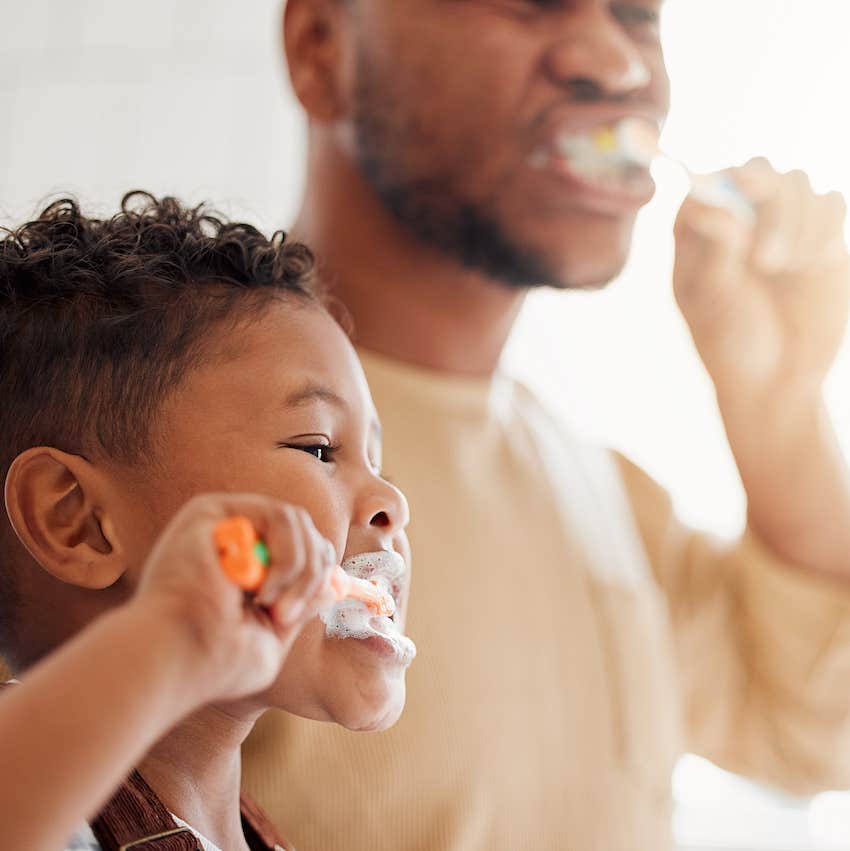 PeopleImages.com – Yuri A / Shutterstock
Like putting on the oxygen mask on a plane, parents have to first deal with their own low self-esteem before they can work with their children.
This can be incredibly difficult for exhausted parents who feel like they fail regularly, but it’s crucial to raising children who feel good about themselves.
Dr. Lis recommends cognitive behavioral therapy to start, as well as the book Feeling good, the new mood therapy by Richard Burnswhich provides more insight into why it takes so long to reverse negative self-perceptions, but it is possible and probably worth it.
“Children learn to see the world through the eyes of their caregivers,” warns Lis. “If parents put themselves down, fear, or distrust others, they are likely to pass these traits on to their children.”
Like a treehouse or a bunk bed, self-esteem can be difficult for parents to develop, but just because you grew up without it doesn’t mean your child should grow up without it, too.
Lauren Vinopal is a writer who focuses on parenting, family, and self-love.













Leave a Reply